
SuprAnalytics vs Matomo
Looking for a Matomo alternative?
Compare Matomo and SuprAnalytics for website analytics, payment attribution, visitor journeys, live chat, privacy, hosting, and pricing.
Matomo is a comprehensive analytics platform with extensive configuration, which you can self-host or use in its cloud. SuprAnalytics brings website analytics, payment-provider attribution and visitor live chat into one simpler, hosted workflow.
14-day free trial · No card required · From $9/month
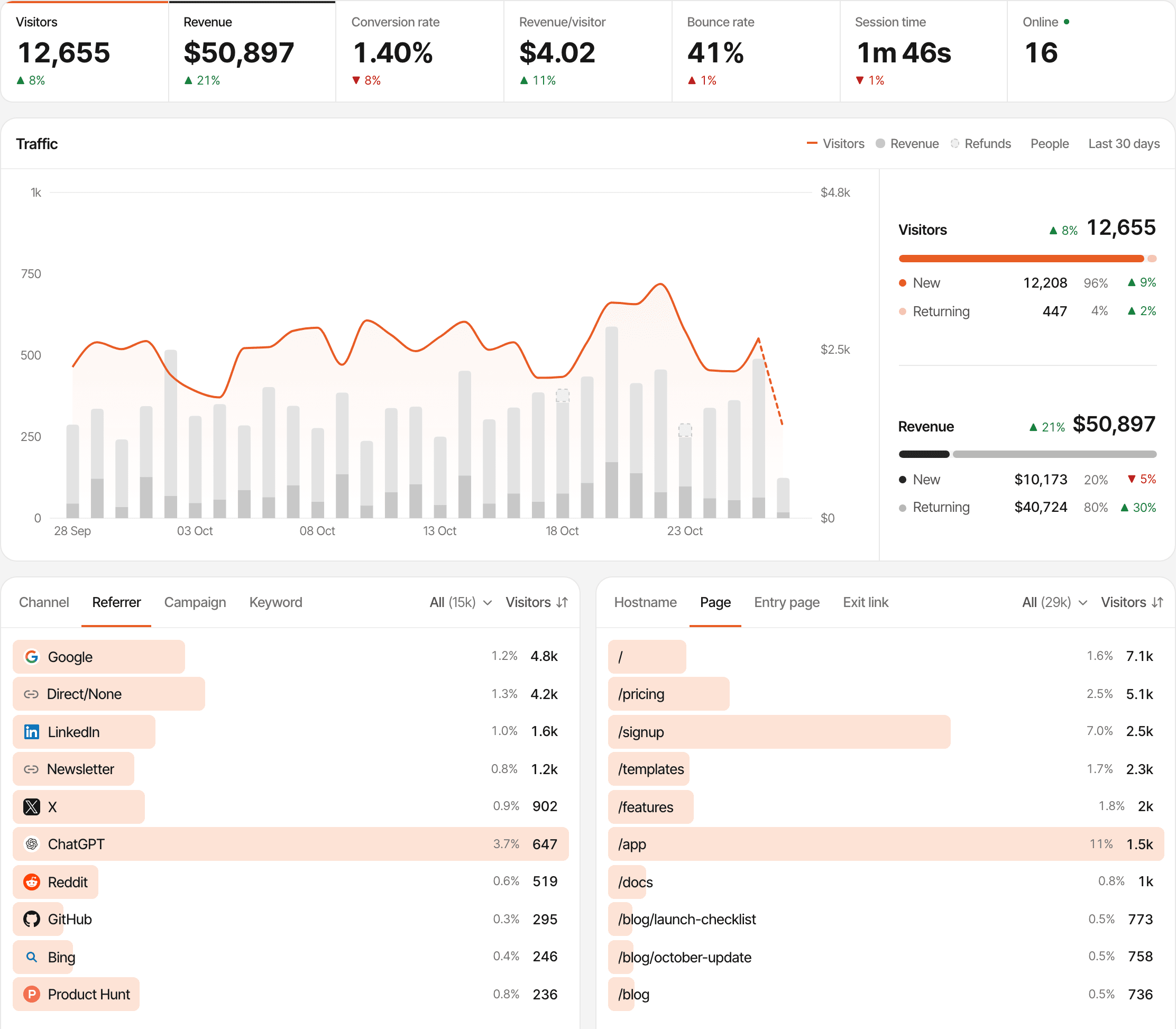
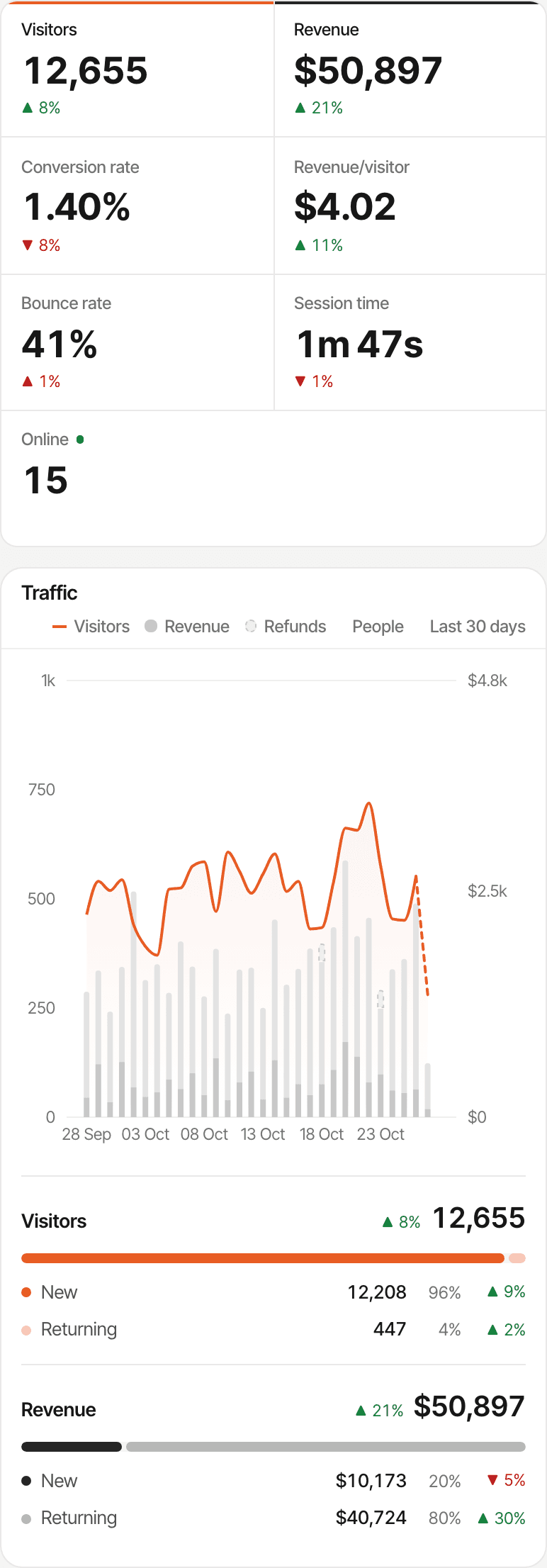
At a glance
Matomo reports more, and can run on your own servers. SuprAnalytics takes payments from your provider, adds live chat, and runs for you.
| Capability | SuprAnalytics | Matomo |
|---|---|---|
| Website traffic analytics | AvailablePages, countries, cities, devices, realtime | AvailableVisits, pages, locations, devices, a Visits Log and real-time |
| Referrer reporting | AvailableChannels and referrers | AvailableReferrers grouped into channel types |
| Campaign tracking | AvailableUTM tags | AvailableUTM source, medium, campaign and term; all six with a free Matomo plugin |
| Custom events | AvailableCustom goals and outbound link clicks | Available |
| Goals | Available | AvailableWith a revenue per goal |
| Funnels | AvailableA funnel step can be a payment | Depends on editionIncluded on Cloud; a paid plugin On-Premise |
| Visitor journeys | AvailableEach visitor's visits, pages, goals, payments and chats | AvailableVisits Log and visitor profiles; User ID links devices |
| Ecommerce revenue | LimitedRevenue from your provider's payments; no product or cart reports | AvailableOrders, products, abandoned carts and revenue by channel, sent by your code |
| Payment-provider attribution | AvailableStripe, Polar, Lemon Squeezy, Paddle, Dodo Payments, and an API | Not listedNo listed integration with these five; orders come from your code or an ecommerce plugin |
| Subscription renewals | AvailableCredited to the customer's original visit | LimitedNo dedicated feature yet; its docs suggest events from your server |
| Refund handling | AvailableFrom the provider; partial refunds vary by provider | Limited“Not fully supported” yet, its docs say |
| Built-in live chat | AvailableWidget and inbox | Not listedThird-party plugins exist |
| AI referral traffic | AvailableAn AI search channel | AvailableAn AI Assistants channel, plus AI agent and chatbot reports |
| Cookie behavior | OptionalA cookie by default; cookieless mode is opt-in | OptionalFirst-party cookies by default; can be turned off, with consent options |
| Self-hosting | Not availableHosted only | AvailableOn-Premise, on your PHP and MySQL server; the software is free |
| Open source | Not available | AvailableGPL v3; paid plugins aren't open source |
| Heatmaps and session recordings | AvailableOff by default; 1,000 to 50,000 recorded sessions a month, by plan | Depends on editionOn Cloud, with monthly caps; a paid plugin On-Premise |
| Read API | Not availableIts API accepts data; stats come through MCP | AvailableA reporting API in core, and an MCP server |
| Team permissions | Not availableNot released yet | AvailableView, Write, Admin and Superuser roles; Cloud up to 30 members |
| Pricing and retention | Monthly from $9, by events; 2 years to 5 years of data | Cloud from €22 (US$26) a month, 24 months of raw data, reports kept; On-Premise: free software |
Last verified: , from Matomo's website, marketplace and code (5.14.2). Matomo's cells describe its free core, on Matomo Cloud and self-hosted On-Premise alike, unless they say otherwise; “a paid plugin” is a premium plugin sold separately for On-Premise. “Not listed” means its pages don't describe it. Product details change: see matomo.org and Matomo's pricing.
Powerful analytics, different workflows.
Both can show which sources bring revenue. Matomo gives you more reports and deployment choices, and you send the orders in; SuprAnalytics is narrower, and the payment connection and chat come built in.
Matomo
A comprehensive analytics platform, self-hosted or in its cloud.
- GPL-licensed software you can run on your own servers, or Matomo Cloud, hosted in Frankfurt
- Ecommerce reports with products and carts, goals with revenue, and multi-channel attribution
- Funnels, heatmaps, recordings, A/B tests and more: included on Cloud, paid plugins when self-hosted
- Revenue comes from orders and goals your code sends, from the page or your server
SuprAnalytics
Hosted analytics wired to your payments and your visitors.
- Nothing to run: one script, hosted for you
- Payments arrive from your payment provider, with renewals and refunds, and are tied to the visitor and the source
- Each visitor's pages, goals, payments and chats, in order
- A live chat with visitors, from the same script
Connect your traffic sources to real payments.
Each payment your provider reports is tied to the visitor who made it, so every source shows the customers and revenue it brought.
- Step 1
A visitor arrives
From a search, a referrer, a campaign or an AI assistant
- Step 2
The visit is recorded
With its source, remembered by a first-party cookie
- Step 3
They reach a supported checkout
Which carries their visitor id
- Step 4
The payment is received
From your payment provider's webhook
- Step 5
It's matched when possible
By visitor id, a customer id it has seen, or an email
- Step 6
Revenue is attributed
To the source, by the model you chose
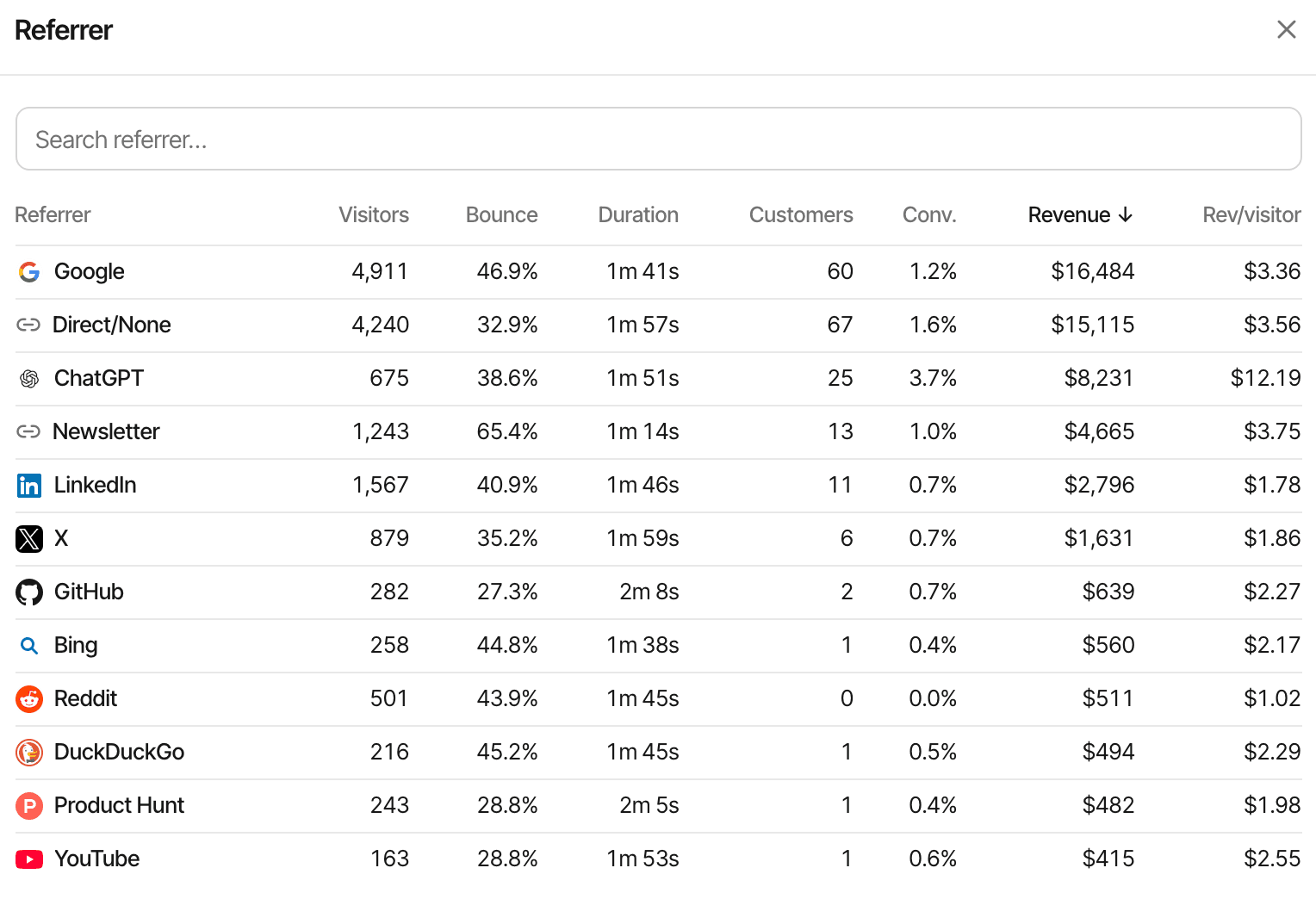
One website's referrers, sorted by the revenue each brought.
First touch
Credits the visit that first brought the customer. Good for “what finds new customers?”
Last touch, the default
Credits the visit the payment happened in. When a customer comes back directly to pay, Direct gets the credit.
Unmatched payments
A payment that can't be matched to a visitor still counts in your revenue, without a source.
Each website picks first or last touch and one reporting currency; payments in other currencies are converted with daily exchange rates. How revenue attribution works
How Matomo does it
Matomo reports ecommerce orders, products, abandoned carts and revenue by channel, and attributes conversions with six models, from first and last interaction to linear and time decay (a paid plugin when self-hosted, included on Cloud). The orders come from your code, on the page or from your server; its docs suggest tracking only confirmed orders, and show a payment confirmation or webhook triggering that server-side code, which you write and host. They also say refunds and partial refunds aren't fully supported yet, and that there's no dedicated subscription feature yet: renewals are tracked as events.
Payment integrations
An ecommerce event says an order happened and what your code thought it was worth. A payment from your provider says what was actually paid, renewed or refunded.
- StripePass the visitor id in your Checkout Session or Payment Link
- PolarCheckout links are tagged by the script
- Lemon SqueezyPass the visitor id as checkout custom data
- PaddlePaddle.js checkout buttons are tagged by the script
- Dodo PaymentsPayment links are tagged by the script
Anything else can send payments through the payments API. Checkouts the script can't see, such as one opened from your own server, need the visitor id passed in your code.
- Renewals are credited to the customer's original visit
- A full refund marks a payment refunded with every provider
- Partial refunds lower a payment with Polar, Paddle (once approved) and Dodo Payments; Stripe's are ignored, with Lemon Squeezy the whole payment is marked refunded, and the payments API refunds a whole payment
What it doesn't do: join visitors across devices on its own, skip direct visits to find an earlier source, report products or carts, import past payments, or report MRR, ARR or churn. Matomo's integrations page and marketplace list ecommerce platforms, such as WooCommerce (a paid Matomo plugin) and Shopify, but no integration with these five payment providers; connecting one means your own code, or a third-party tool.
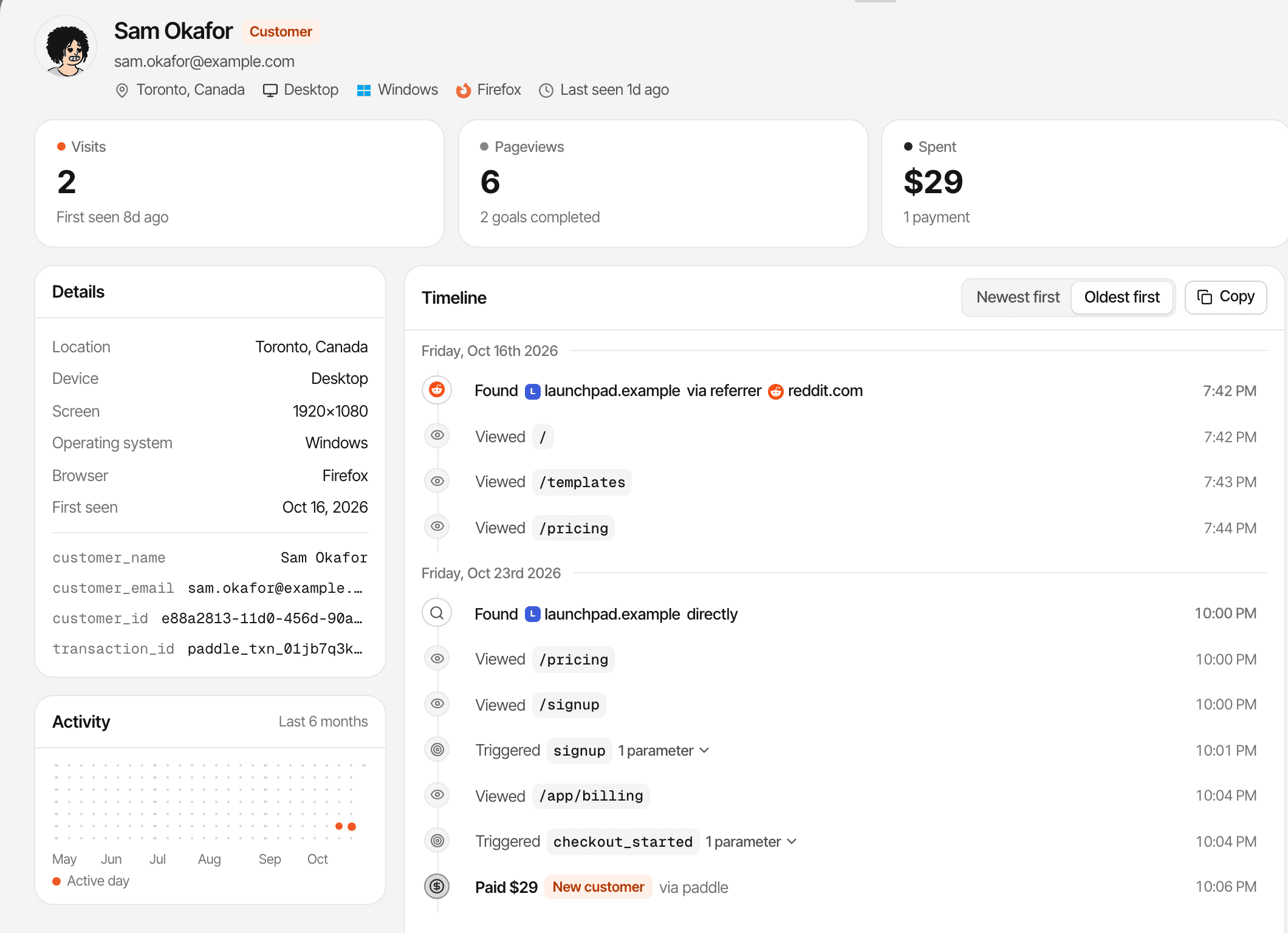
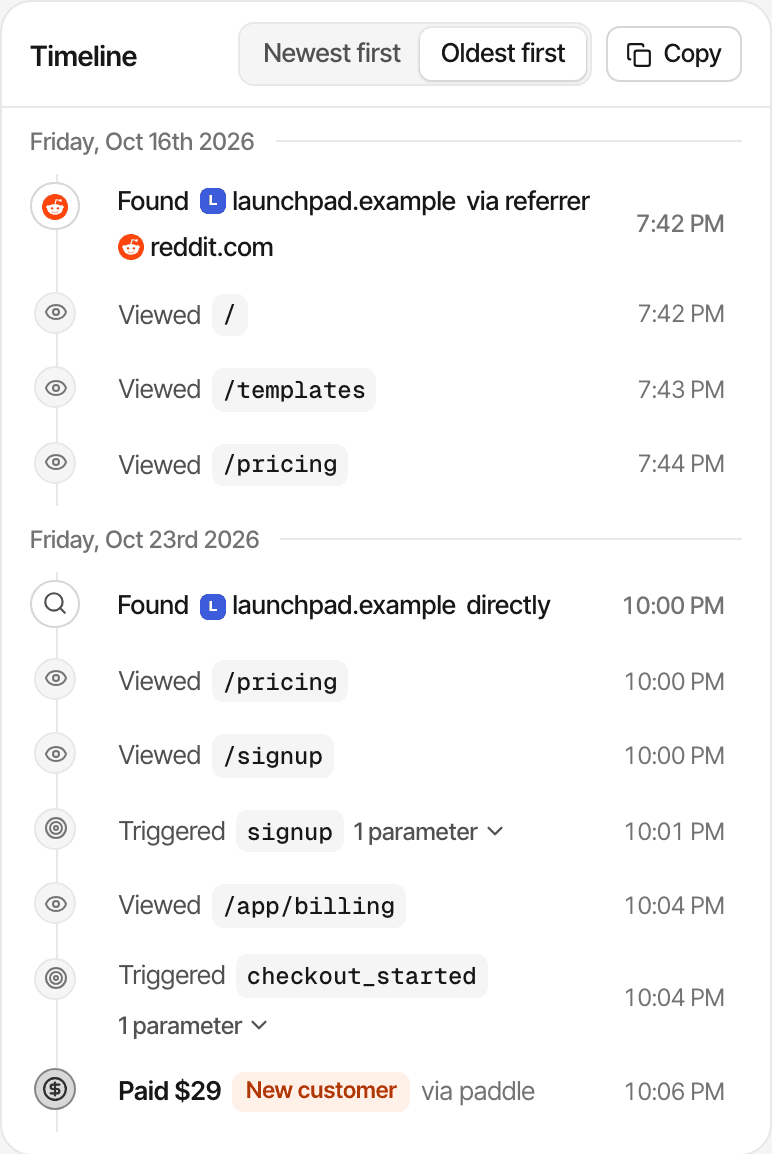
Reddit first, a direct visit to pay through a Paddle button: first touch credits Reddit, last touch credits Direct.
See the path from first visit to conversion.
A journey shows one visitor's path. A funnel shows how everyone moved through the steps you care about, up to the payment.
- The entry source of each visit, with its referrer or UTM tags
- Every page visited, and the goals completed
- Recorded payments, in the same timeline
- The conversation, if they chatted with you
- A name and email only if they give them in chat or your app identifies them
A journey follows one browser: a phone and a laptop are two visitors, and naming them with identify doesn't merge their journeys. In cookieless mode a visitor is recognised for a day. A payment without a visitor id is matched by customer id or email when it can be. About visitor journeys
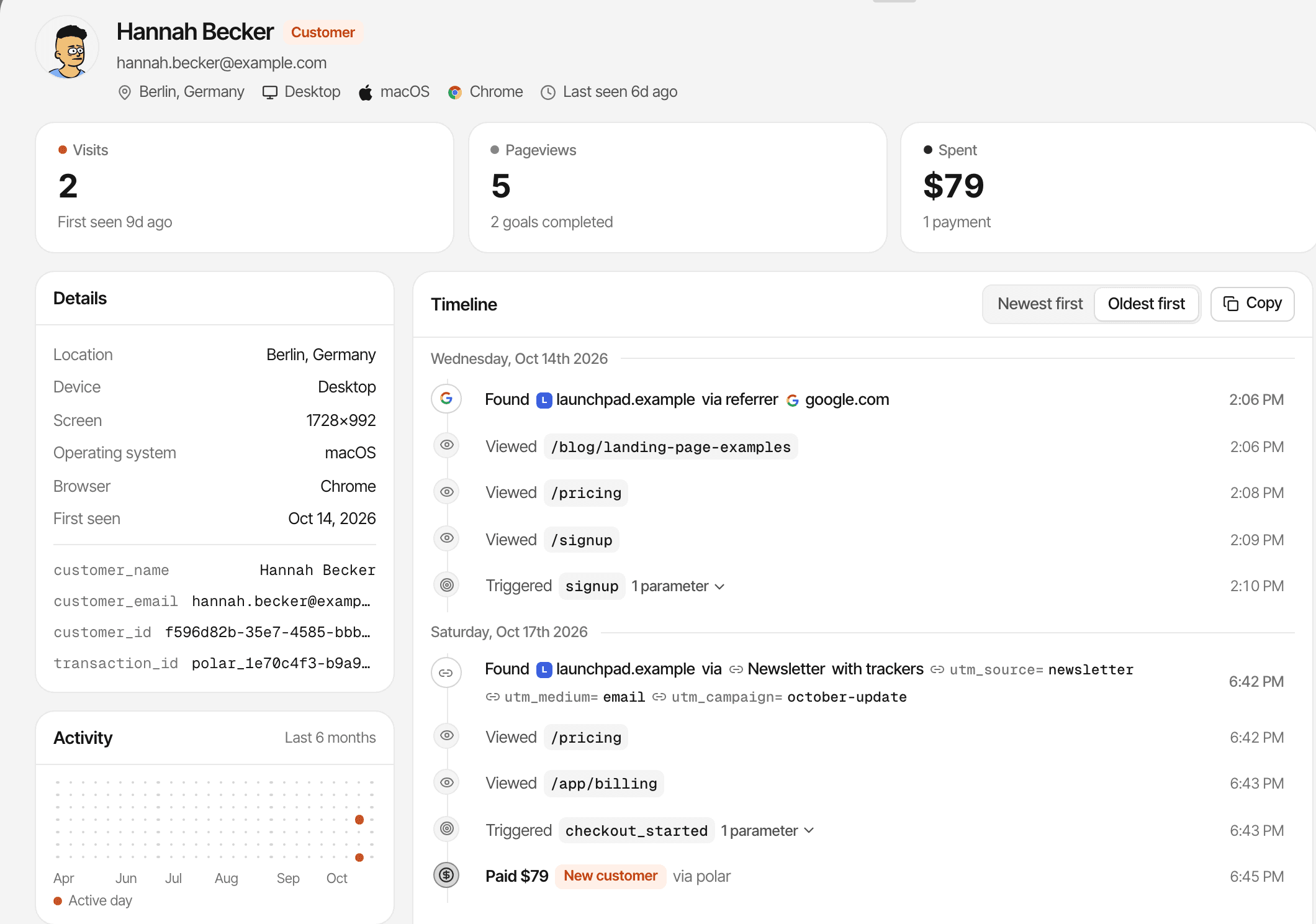
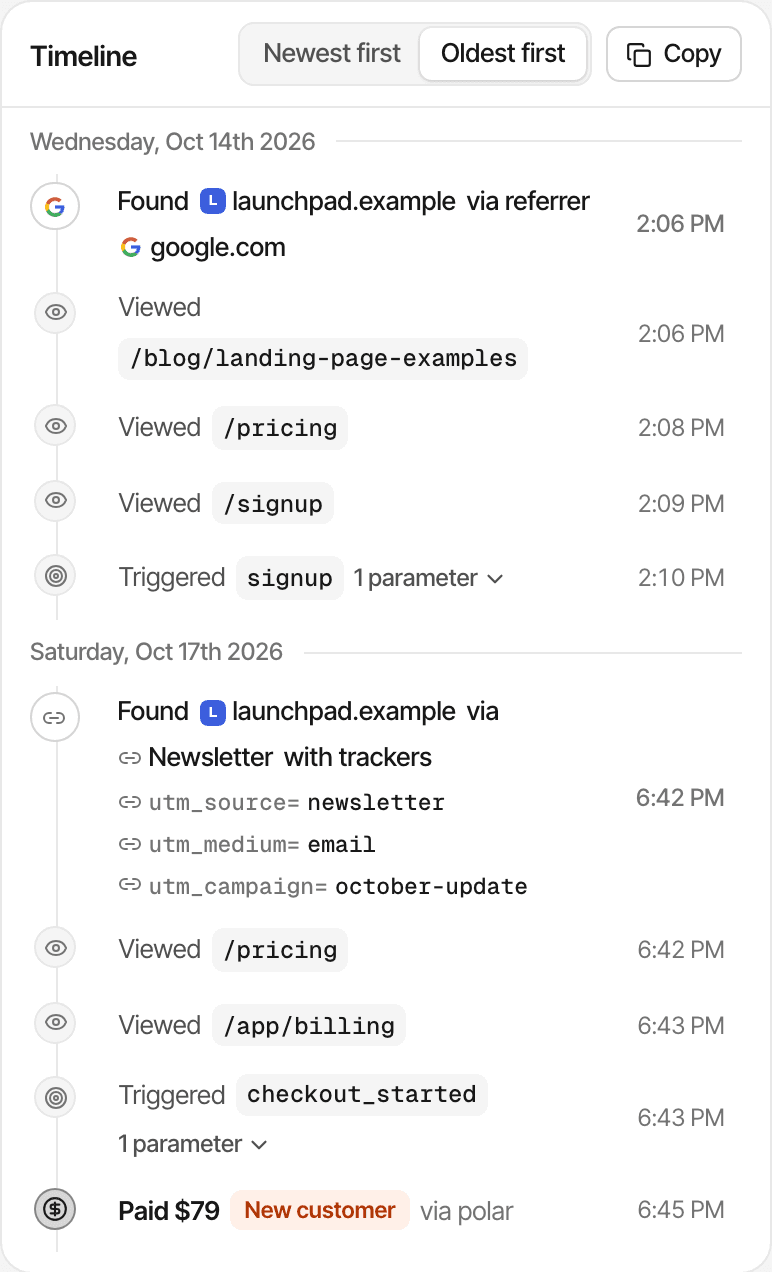
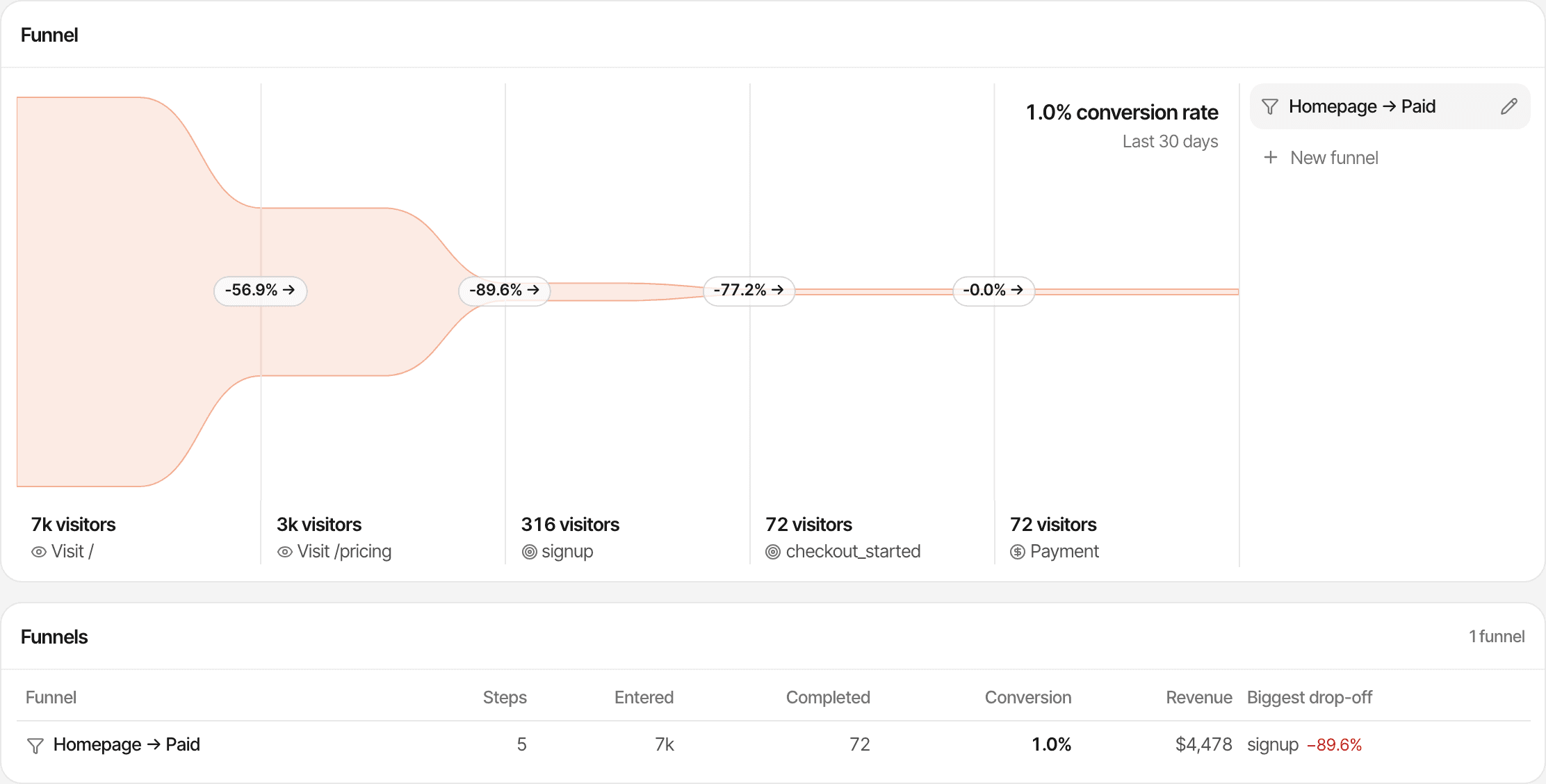
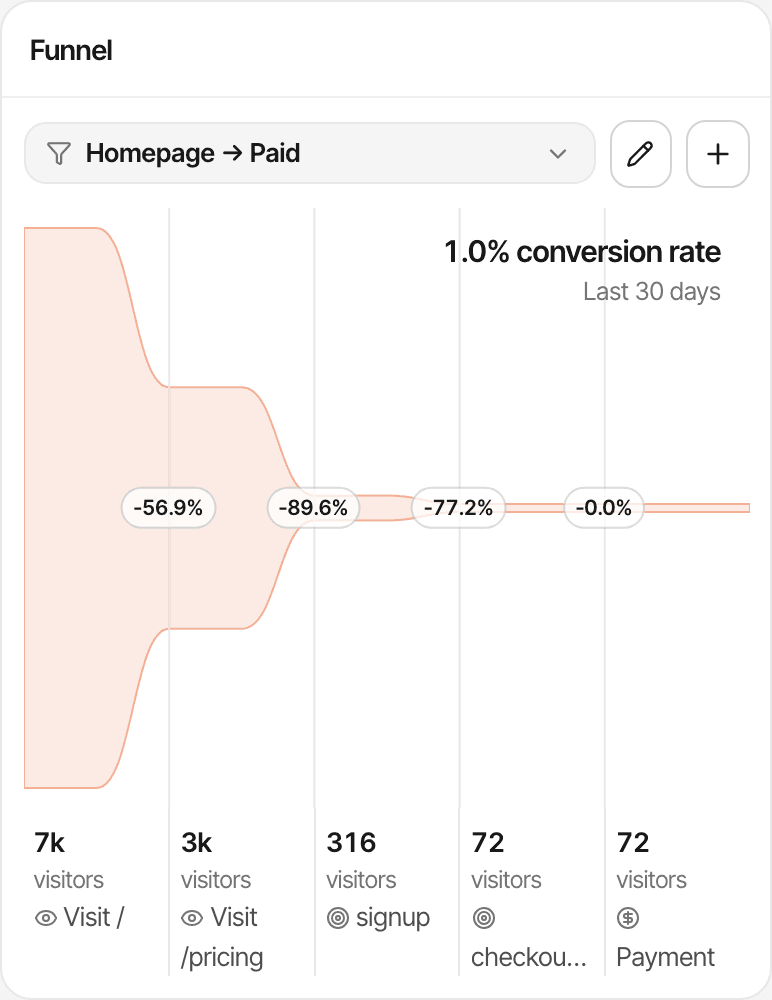
A funnel's last step can be a payment. How funnels work
Matomo has these too: a Visits Log and visitor profiles in its free core, with User ID to link one person's devices, and funnels and a Users Flow report, included on Cloud and paid plugins when self-hosted.
Turn visitor insights into conversations.
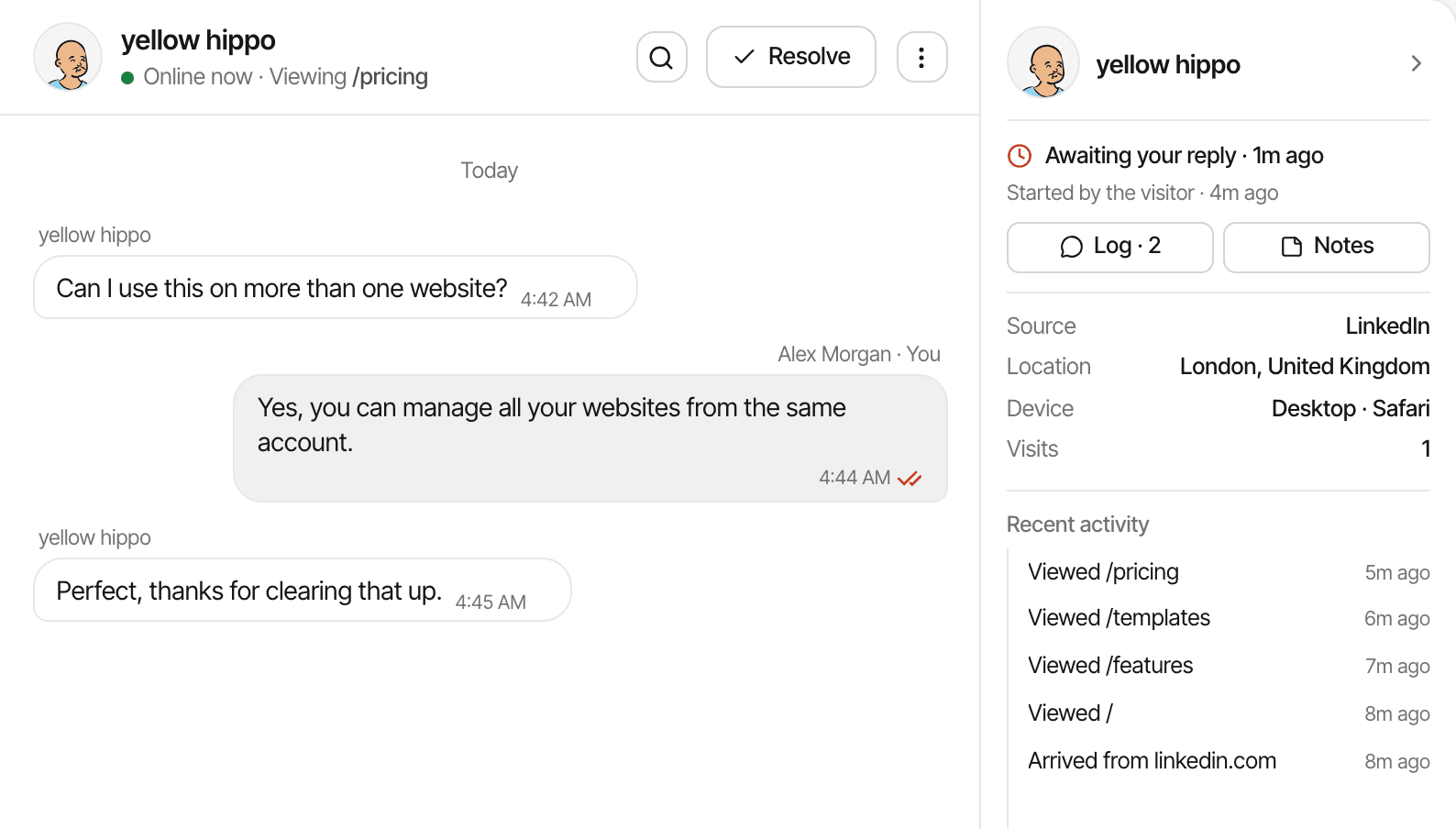
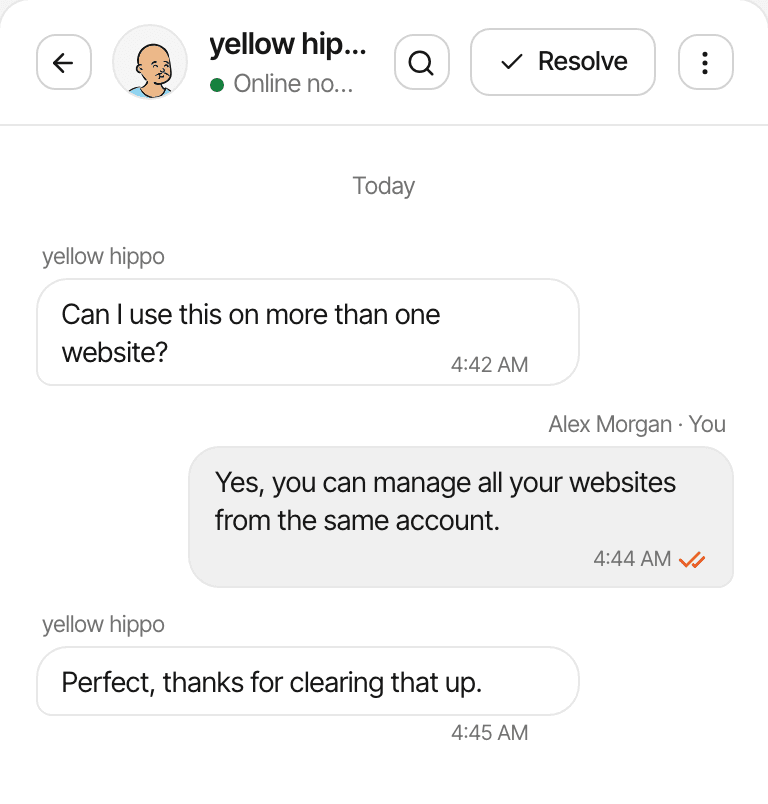
Visitors can message you from a chat bubble that comes with the analytics script, and each conversation opens beside the visit it belongs to.
- A chat widget and one inbox for every website, on every plan
- The visitor's source, the pages they read, their device and location beside each conversation
- The conversation on the visitor's profile, next to their journey
- Messages sent automatically when a visitor opens a page you choose
Visitors stay anonymous unless they type a name or email, or your app identifies them; you still see their visit. Built-in visitor live chat was not listed in the reviewed Matomo documentation; its marketplace has third-party chat plugins, and a chat tool can be added alongside it. More about live chat
Where Matomo may be better
Matomo is a mature, comprehensive analytics platform. If one of these matters most to you, it's probably the better fit.
Open source, and yours to run
Matomo's core is GPL-licensed and free to download, so you can run it on your own servers and keep the data there. You also take on the server, PHP and MySQL or MariaDB, updates, backups and security, and their cost. Its paid plugins aren't open source. SuprAnalytics is hosted only, and not open source.
Infrastructure and data location
Self-hosted, you choose where the data lives; Matomo Cloud stores it in Frankfurt, Germany. Matomo says you remain the sole owner of your data and can ask for a full raw export. SuprAnalytics offers no EU hosting option.
Deeper ecommerce and attribution
Products, carts and abandoned carts, revenue per goal and by channel, and multi-channel attribution with six models, including linear, position based and time decay (a paid plugin self-hosted, included on Cloud). SuprAnalytics has first and last touch only, and no product reports.
Behaviour analytics
Heatmaps, session recordings, form analytics and A/B tests: paid plugins when self-hosted, included on Cloud with monthly caps on heatmaps and recordings. SuprAnalytics has heatmaps and session recordings, with a monthly quota by plan, but no form analytics or A/B tests.
More ways to report
A tag manager, segments, custom dimensions and scheduled reports in its free core, with custom reports, cohorts and roll-ups as paid plugins or on Cloud. SuprAnalytics has a fixed set of reports.
APIs, roles and enterprise needs
A reporting API and an MCP server, four user roles, public read-only access, white labelling, and SAML or LDAP sign-in on Cloud Enterprise. SuprAnalytics' API only accepts data, and team access isn't released yet.
Privacy controls
IP masking on by default, consent functions in the tracker, GDPR tools to export or delete a visitor's data, and a mode configured for France's CNIL exemption, which turns several reports off. SuprAnalytics sets a first-party cookie unless you turn cookieless mode on.
Imports and history
A free importer brings in Google Analytics reports (aggregated, not raw visits); on Cloud, reports are kept forever and raw data for 24 months. SuprAnalytics imports nothing, and keeps 2 years to 5 years of data by plan.
The trade-offs: a self-hosted Matomo is yours to run and keep updated, and paid plugins add to its bill. Neither product makes analytics compliant by itself: what you collect, how you configure it, and where you are still matter.
Which product should you choose?
Two honest lists. Pick the one that reads like your situation.
Choose SuprAnalytics if
- You want payments from Stripe, Polar, Lemon Squeezy, Paddle or Dodo Payments attributed without writing a webhook handler.
- You want renewals and refunds counted as your provider reports them.
- You want to chat with visitors, with their visit beside the conversation.
- You'd rather not run servers, databases or updates for your analytics.
- You run many websites and want them all on one plan, from $9 a month.
Choose Matomo if
- You want open-source analytics you can self-host and control.
- You need ecommerce reports with products and carts, or attribution models beyond first and last touch.
- You want A/B tests or form analytics in your analytics tool.
- You need a reporting API, user roles, white labelling or enterprise sign-in.
- You want to import Google Analytics reports, or keep reports indefinitely.
How does the pricing compare?
Three ways to pay: SuprAnalytics' monthly plans, Matomo Cloud's plans, and Matomo On-Premise, where the software is free and the server, upkeep and any paid plugins are yours.
SuprAnalytics
- 6 monthly plans, from $9 for 100,000 events to $149 for 5 million
- Every feature and unlimited websites on every plan
- Counts pageviews, custom goals and outbound link clicks; never chat messages or payments
- 2 years to 5 years of data history, by plan
- Past the allowance, recording continues to 20% over, then pauses; no overage charges
- 14-day free trial, no card. No free plan. Monthly billing only
- Hosted for you: no servers or updates
Matomo Cloud
- From €22 (US$26) a month for 50,000 hits, excluding tax; priced by monthly hits
- A hit is a pageview, event, download, outlink, site search or content interaction
- Billed monthly, or yearly with two months free
- Business plan: 30 websites, 30 team members, and premium features such as funnels and attribution included, heatmaps and recordings with monthly caps; Enterprise at a custom price
- 24 months of raw data; reports kept forever
- Over the allowance, overage fees are charged
- 21-day free trial, no card. Hosted in Frankfurt, Germany
Matomo On-Premise
- Free software under the GPL, with no hit limit
- You provide the web server, PHP and a MySQL or MariaDB database, and pay for them
- You handle updates, backups, security and uptime
- Premium features are paid plugins, per year and priced by number of users: Funnels from €193, Heatmaps & Session Recording from €219
- Or plugin bundles, from €230 a month
- Data kept until you delete it
Last verified: . Matomo shows prices in the currency of your location; these are its euro and dollar prices. At 1 million a month: $49 for SuprAnalytics, US$204 (€172) for Matomo Cloud, which includes its premium features. The allowances count a little differently: Matomo counts hits, which include downloads and site searches; SuprAnalytics counts pageviews, goals and outbound clicks.
Switching from Matomo
There's no automatic migration. Here is what moving involves.
Create a SuprAnalytics account
The 14-day trial needs no card. Keep Matomo running for now: SuprAnalytics can't import its data, so your history stays in your Matomo installation or Cloud account.
Install the tracking script
One tag in the
<head>, next to Matomo's while you compare, or the guide for your platform. Need no cookies? Turn on cookieless mode.Check that events arrive
Open your website and watch the visit appear in the realtime view.
Connect your payment provider
Instead of sending ecommerce orders, let the payments come from your provider. How to connect one
Compare before you switch off
Run both for a few weeks. Expect different numbers: each tool has its own visitor rules and filters. Compare trends, not exact counts, and keep or export what you need from Matomo, whose history stays where it is, before you retire it.
Questions, answered.
What is the difference between Matomo and SuprAnalytics?
Is SuprAnalytics a Matomo alternative?
Is Matomo open source?
Can Matomo be self-hosted?
Does Matomo support ecommerce and revenue tracking?
Can SuprAnalytics attribute Stripe payments to traffic sources?
Does SuprAnalytics include live chat?
Does SuprAnalytics support cookieless tracking?
Can I import historical Matomo data?
Which product is better for SaaS founders?
Matomo sources, read on (its code at 5.14.2): Homepage · Pricing · On-Premise · Licence · GitHub · Ecommerce reports · Server-side ecommerce · Subscriptions · Multi-channel attribution · Funnels · Cookies · Consent · Cloud trial · Requirements · Marketplace
More comparisons
- vs Google AnalyticsFree, deep acquisition reports and Google Ads, or payments tied to each visit and a live chat.Open
- vs PlausibleSimple cookieless stats, or revenue attribution and visitor chat on top.Open
- vs PostHogA product engineering platform, or a focused website workspace.Open
- vs FathomPrivacy-first website stats, or traffic tied to payments and conversations.Open
- vs RybbitOpen-source, cookieless analytics, or payments by source and live chat.Open
- vs DataFastTwo revenue-first tools: live chat and unlimited websites set them apart.Open
- vs SelineLightweight analytics, or revenue from five payment providers and chat.Open
- vs Simple AnalyticsPrivacy-first simplicity, or payments credited to each traffic source.Open
- vs UmamiOpen-source, self-hostable stats, or hosted revenue attribution and chat.Open
- vs MixpanelEvent-based product analytics, or website traffic tied to payments.Open
- When not to use SuprAnalyticsThe cases where another tool fits better, and which one.Open
Understand your visitors. Connect traffic to revenue.
Track acquisition, follow visitor journeys, and see which sources bring paying customers, with live chat in the same workspace.
14-day free trial · No card requiredvs Plausiblevs Rybbit